On November 3, 2026, Tazewell County voters will decide on a proposed 1% County Schools Facility Tax — commonly known as the One-Cent Tax — to fund school facility improvements and safety upgrades across our public schools. School districts throughout the county have united to bring this measure to voters.

On Tuesday, November 3, 2026, school districts in Tazewell County are asking voters to consider a 1% Illinois County Schools Facility Tax also known as a one-cent tax or sales tax. The one-cent tax would fund improvements to school facilities, creating safer, modern learning environments, while lessening the burden on homeowners by offering an alternative funding source for local schools.

It’s estimated nearly 60% of the one-cent tax revenue would be generated by visitors, commuters and non-residents of Tazewell County. Items not currently subject to sales tax– such as groceries, medications, vehicles, farm equipment, and services– would not be taxed under this proposal.


How the Funds Will Be Used

By law, the revenue generated by the one-cent tax would be dedicated to:

  • Facility improvements, such as roof repairs, energy efficiency updates, renovations, durable equipment, and new school buildings
  • Safety and security improvements, including fire prevention, life safety measures, school resource officers, and mental health services
  • Paying off facility bonds and/or reducing property taxes.

If approved, each school district in Tazewell County would receive funding based on the number of students enrolled. Each school district decides how to allocate funds to meet their school community’s needs. A breakdown of estimated revenue for local districts is available to view.

Ballot Question

“Shall a retailers’ occupation tax and a service occupation tax (commonly referred to as a “sales tax”) be imposed in The County of Tazewell, Illinois, at a rate of 1% to be used exclusively for school facility purposes, school resource officers, and mental health professionals?”


Items Not Taxed Under This Proposal

  • Groceries
  • Prescription medications
  • Vehicles (cars, trucks, boats)
  • Farm equipment
  • Professional/Personal Services (haircut, accounting, legal, etc.)
  • Wholesale purchases


The One-Cent Tax applies only to purchases currently subject to Illinois sales tax. Example purchases include:

  • Coffee at Starbucks ($5): 5¢
  • Laptop at Best Buy ($500): $5
  • T-shirt at Target ($20): 20¢

Reducing the Reliance of Property Taxes to Fund our Schools

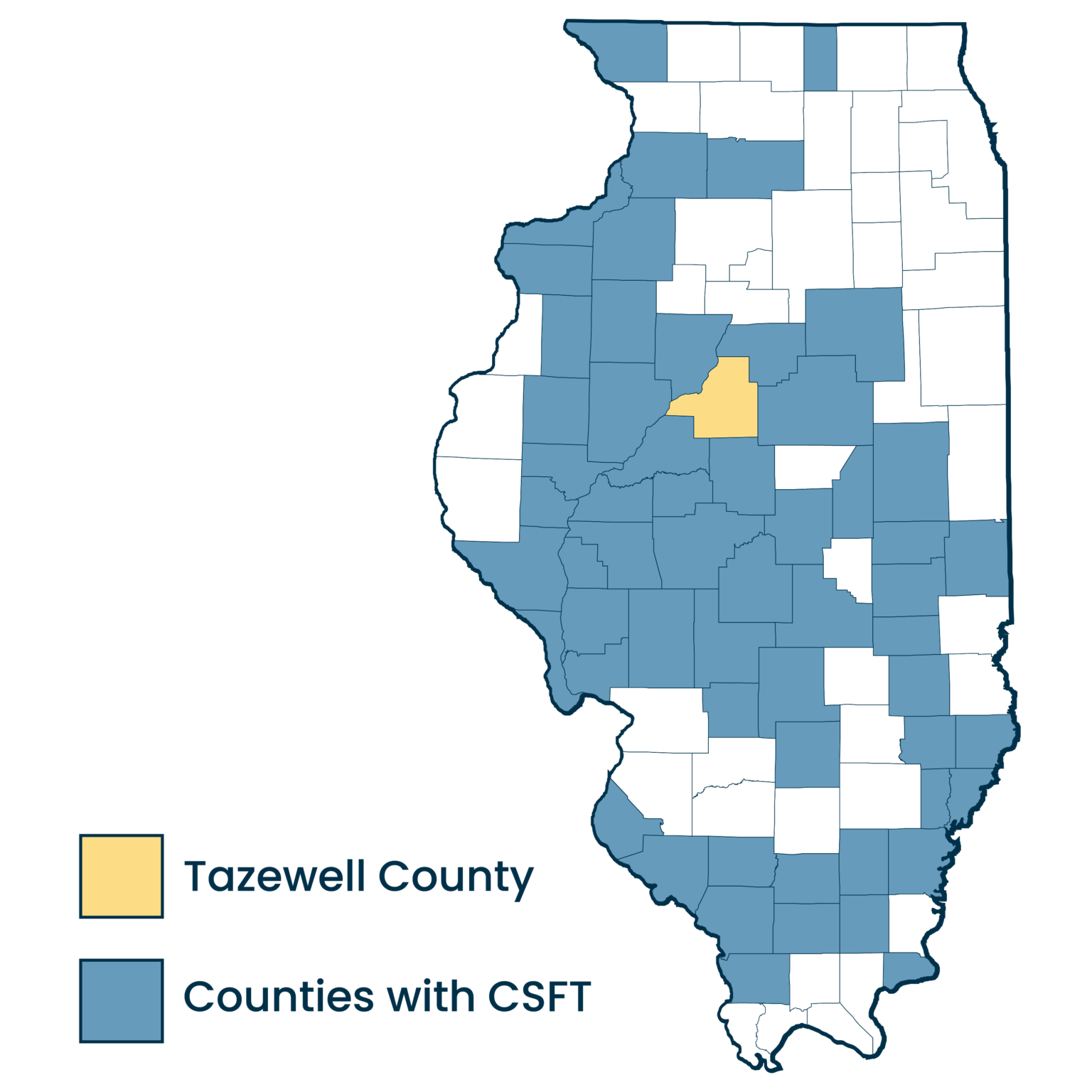
Every county that surrounds Tazewell already has a sales tax that supports its schools. A majority of counties in Illinois have a County Schools Facility Tax in place. When Tazewell County residents shop and dine in these counties, they are supporting those local schools.

If approved, each school district in Tazewell County would receive a share of the new one-cent tax revenue based upon student enrollment.

The funds would be distributed equally according to the number of students enrolled in each district, and each district’s Board of Education would decide how to allocate the funding within the state’s guidelines.


Frequently Asked Questions

Below are some frequently asked questions and answers to provide residents with more information about the one-cent tax referendum on November 3rd.

What is a County Schools Facility Sales Tax (CSFT) or One-Cent Tax?
  1. The Illinois County Schools Facility Sales Tax (CSFT) is a 1% sales tax option, commonly known as a one-cent tax, available to Illinois voters since 2007. If approved, it can shift funding for school facilities from property taxes to sales tax (Public Act 97-0542). Since 2007, nearly 60% of Illinois counties have approved a CSFT, including surrounding counties such as McLean, Peoria, Woodford, Fulton and Mason.

If approved, one cent per dollar spent would be applied to qualifying purchases made within the county to support public schools and offer property tax relief. For example, on a $1 purchase, one cent would be added to the price for qualifying purchases. Items that are not currently taxed under Illinois law, are not taxed under the County Schools Facility Tax.


What are a few examples of how much the one-cent tax will cost?

Here are some examples of what the one-cent tax would cost on common, qualifying purchases:

  • A coffee at Starbucks $5 = .05 cents
  • Laptop at Best Buy $500 = $5
  • Book purchase on Amazon $5 = .05 cents
  • T-shirt at Target $20 = .20 cents
  • Bag of apples at Kroger $5 = No increase
  • Medicine = No increase
If approved, how will the funds be used?
  1. If approved, the revenue generated from this one-cent tax would provide: 

Facility maintenance and upgrades: Maintaining and improving our school facilities is crucial for creating an optimal learning environment. Funds can be used for necessary repairs and upgrades to school buildings and facilities, including HVAC systems, parking lots, and other general maintenance. These improvements ensure that our schools remain safe, up to code, and equipped to meet the needs of today’s students.

Safety and security needs and supports: The safety of our students, staff, and visitors is a top priority for our schools. The revenue raised through this tax can directly support school security needs, such as surveillance systems, secure entry points, and School Resource Officers.

Supporting students academically, socially and emotionally is also key to their success. This additional revenue can help expand access to mental health professionals and resources for students that may need extra support to thrive. These items help ensure that our students and staff are in a safe and supportive environment, which is essential for learning and well-being.


Reduce reliance of property taxes to fund schools: If approved, the revenue generated from this one-cent tax will provide an alternative source of funding for schools, reducing the reliance on property taxes. Unlike property taxes, which primarily impact homeowners, this one-cent tax would apply to qualifying purchases throughout the county. This option helps fund critical improvements for schools while easing the financial burden on property owners. This broadens the tax base to include visitors, non-residents and renters who shop in the county offering a more equal way to support public schools.

The revenue from this one-cent tax can help improve school facilities and provide safety, security and support for our students.

What happens if this question fails?

Projects will be delayed with project costs likely increasing. School districts will be faced with seeking alternative options, such as property tax increases, to fund essential facility improvements and safety and security needs.

Why are school districts asking voters now?
  1. School leaders understand tax payers are under pressure from increasing property tax rates and cost of living expenses. At the same time, school districts across Illinois are also facing financial challenges due to rising operational costs, aging facilities, and increased safety, security, and support needs for students. Many schools across Tazewell County are facing critical facility needs as schools built in different eras require significant updates to meet safety and learning standards.

The proposed 1% sales tax would help raise an estimated $22 million annually for school districts, with approximately 60% of the funds coming from people who live outside of Tazewell County. This would prevent needing to possibly raise property taxes, while providing some relief by lessening the burden on local property tax payers.

What can be taxed?

Only items that are currently subject to sales tax will be subject to the CSFT. Some items are exempt from CSFT.

Example purchases that would be taxed include: Coffee at Starbucks ($5): 5¢ Laptop at Best Buy ($500): 60¢ T-shirt at Target ($20): 20¢

What items are not taxed under the County Schools Facility Tax?

Items that are not currently taxed under Illinois law, are not taxed under the County Schools Facility Tax. Items not subject to the one-cent tax include:

  • Groceries
  • Over the counter medicine and prescription drugs
  • Cars, trucks, ATV’s boats, RV’s, mobile homes
  • Farm equipment, parts, inputs
  • Services (accounting, legal, etc.)
  • Wholesale level purchases
How can revenue through the one-cent tax be used?

By law, the revenue generated by this one-cent tax must be used for:

  • Paying off facility bonds and/or property tax reduction
  • Facility improvements including:
    • New school facilities including athletics
    • Additions and renovations
    • Land acquisition
    • Architectural planning
    • Energy efficiency improvements
    • Durable equipment
    • Demolition
    • Roof repairs
  • Safety and security improvements including fire prevention and life safety
  • School Resource Officers and Mental Health Providers
How can revenue not be used?

Funds from the one-cent tax may not be used for staff salaries and benefits*, instructional supplies, books, computers, buses, or other operating expenses.

(*Recent changes in Illinois CSFT allow schools to use these funds only for salaries/benefits for School Resource Officers and/or Mental Health Professionals)

Who decides how funds are used to support each school district?

Each school district’s Board of Education determines how to allocate the funding within the state’s guidelines.

If approved, will every school district in Tazewell County benefit?

Yes. Every school district in the county will benefit. The one-cent tax revenue will be collected from all cities and townships in the county and distributed to school districts based upon student enrollment.

How is the revenue distributed?
Revenue is distributed based upon the number of students living in the county and attending public schools, regardless of which school they attend.
School DistrictStudents Residing in Tazewell CountyPayment BreakdownSchool Percentage
Payment Received$22,200,739.00$222,007.39
Divided by total number of students$1,181.52
District 50549$648,6542.92%Washington Community$4,701,263
Central 511269$1,499,3476.75%East Peoria Community$2,637,150
Washington 52808$954,6674.30%Pekin Community$5,717,370
Creve Coeur 76427$504,5092.27%
Robein 85138$163,0500.73%
East Peoria 861387$1,638,7677.38%
Rankin 98201$237,4851.07%
NPMH 102459$542,3172.44%
Pekin 1083115$3,680,43116.58%
South Pekin 137186$219,7630.99%
Pekin 3031724$2,036,9389.18%
WCHS 3081353$1,598,5957.20%
EP 309845$998,3834.50%
Spring Lake 60655$64,9840.29%
Deer Creek – Mackinaw 701896$1,058,6414.77%
Tremont 702859$1,014,9254.57%
Delavan 703359$424,1651.91%
Morton 7093228$3,813,94317.18%
Hartsburg Emden 210$00.00%
Illini Central 18917$20,0860.09%
Midwest Central 191343$405,2611.83%
Olympia 16510$602,5752.71%
Germantown 690$00.00%
Metamora High 1220$00.00%
Eureka 14062$73,2540.33%
Totals18790$22,200,739100.00%
How much new money would each district receive if approved?
School District NameApproximate Number of Students in McLean CountyEstimated Annual Share of County School Facility Tax Revenue
Bloomington SD 874,841$6,253,117
Blue Ridge 18 63$81,377
El Paso Gridley 11344$444,345
Gibson City Melvin Sibley 5 12$15,500
Heyworth CUSD 4 877 $1,132,820
LeRoy CUSD 2 755 $975,233
Lexington CUSD 7 511 $660,058
McLean Unit 5 12,340 $15,939,571
Olympia CUSD 16726 $937,774
Prairie Central 8 326 $421,094
Ridgeview CUSD 19 520$671,684
Tri Valley CUSD 3 1,131 $1,460,912
Total 22,446 $28,993,485
Will revenue be generated from people who live outside of Tazewell County?

Yes. Revenue will be generated from people who live outside of Tazewell County. Any person who is visiting or traveling through the county and makes a purchase that qualifies would contribute to the revenue for local schools. It is estimated that 60% of all purchases in Tazewell County are made by non-residents. Additionally, not all of the remaining 40% of purchases are made by property owners in this county– This one-cent tax would allow non-property owners to help support local schools, reducing some of the financial burden on property owners.

How does the proposed one-cent tax for McLean County compare to surrounding counties?

If approved, Tazewell County will join all of its neighboring counties that are investing in their schools through a CSFT.
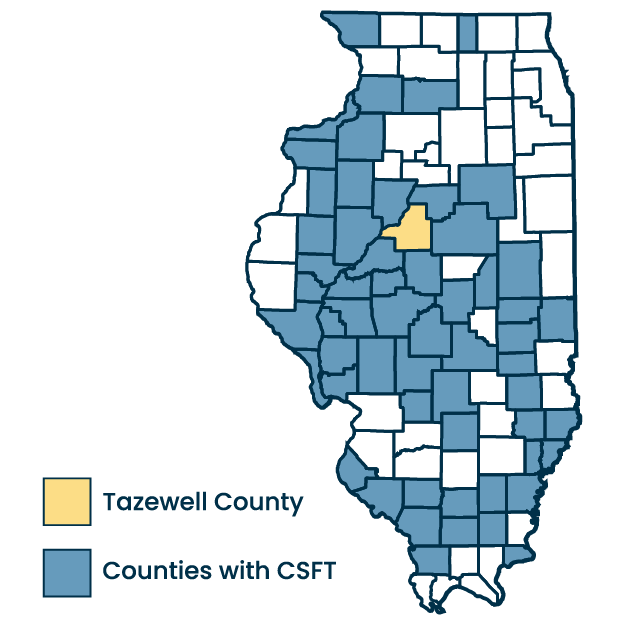
tazewell-county-map

What is the ballot question?

Shall a retailers’ occupation tax and a service occupation tax (commonly referred to as a sales tax) be imposed in The County of Tazewell, Illinois, at a rate of 1% to be used exclusively for school facility purposes, school resource officers, and mental health professionals?

When and how do I vote

Election day is Tuesday, November 3, 2026. Polls are open 6 a.m. to 7 p.m. on Election Day. Early voting is available starting September 24. For details about how to vote, including voting locations and how to register, visit www.elections.il.gov.

How can I learn more?

To learn more, contact your local school district by visiting their website or attend an upcoming informational meeting. 
Resources

As the April 1, 2025 election approaches, we’re committed to keeping you informed every step of the way. In the coming weeks, we’ll be adding campaign resources to this page.

Voting Information

Election Day is Tuesday, November 3, 2026  |  Polls open: 6:00 a.m. – 7:00 p.m.

Early Voting begins September 24, 2026

For details on voter registration, mail-in voting, polling locations, and more, visit www.elections.il.gov.

Early Voting Information for the April 1 Election in McLean County

Residents of McLean County can vote early in the upcoming April 1 Consolidated Election. Early voting is available at different locations based on your residency in McLean County.

McLean County Election Authorities:

Early In-Person Voting for McLean County (excluding City of Bloomington residents)

Residents of McLean County (outside the City of Bloomington) can vote early at the McLean County Clerk’s Office, located at the Government Center, 115 E. Washington St., Bloomington, IL. 

Early Voting Dates and Hours at the McLean County Clerk’s Office:

  • Thursday, Feb. 20 – Friday, Feb. 21: 8:30 AM – 4:30 PM
  • Monday, Feb. 24 – Friday, Feb. 28: 8:30 AM – 4:30 PM
  • Monday, March 3 – Friday, March 7: 8:30 AM – 4:30 PM
  • Monday, March 10 – Friday, March 14: 8:30 AM – 4:30 PM
  • Monday, March 17 – Friday, March 21: 8:30 AM – 4:30 PM
  • Saturday, March 22 – Sunday, March 23: 9:00 AM – 5:00 PM
  • Monday, March 24 – Friday, March 28: 8:30 AM – 7:00 PM
  • Saturday, March 29 – Sunday, March 30: 9:00 AM – 5:00 PM
  • Monday, March 31: 8:30 AM – 7:00 PM

Early Voting for Residents of the City of Bloomington

Residents of the City of Bloomington can vote early at the Bloomington Election Commission, located at 121 N. Main St., Bloomington, IL.

Early Voting Dates and Hours at the Bloomington Election Commission:

  • Thursday, Feb. 20 – Friday, Feb. 21: 8:30 AM – 4:30 PM
  • Monday, Feb. 24 – Friday, Feb. 28: 8:30 AM – 4:30 PM
  • Monday, March 3 – Friday, March 7: 8:30 AM – 4:30 PM
  • Monday, March 10 – Friday, March 14: 8:30 AM – 4:30 PM
  • Monday, March 17 – Friday, March 21: 8:30 AM – 4:30 PM
  • Saturday, March 22 – Sunday, March 23: 9:00 AM – 5:00 PM
  • Monday, March 24 – Friday, March 28: 8:30 AM – 7:00 PM
  • Saturday, March 29 – Sunday, March 30: 9:00 AM – 5:00 PM
  • Monday, March 31: 8:30 AM – 7:00 PM

Vote Early by Mail

Residents can also vote early by mail. To vote by mail:

  1. Submit a Vote By Mail Online Application, OR
  2. Print the mail-in form and mail it to the appropriate election office (McLean County Clerk’s Office or City of Bloomington Election Commission).
  3. Call your local election office to request a Vote by Mail Application pre-printed with your voter information, 
  4. Visit your designated election office to complete the form in person.

For more details to vote by mail, follow the links based on your residency:

Register to Vote and Cast Your Ballot

If you are not registered to vote, you can register and vote at the early voting locations. Be sure to bring the required identification, with at least one form showing your current address. You can also register to vote online.

For more information on early voting in Illinois, visit the Illinois State Board of Elections page on Early Voting in Illinois.